
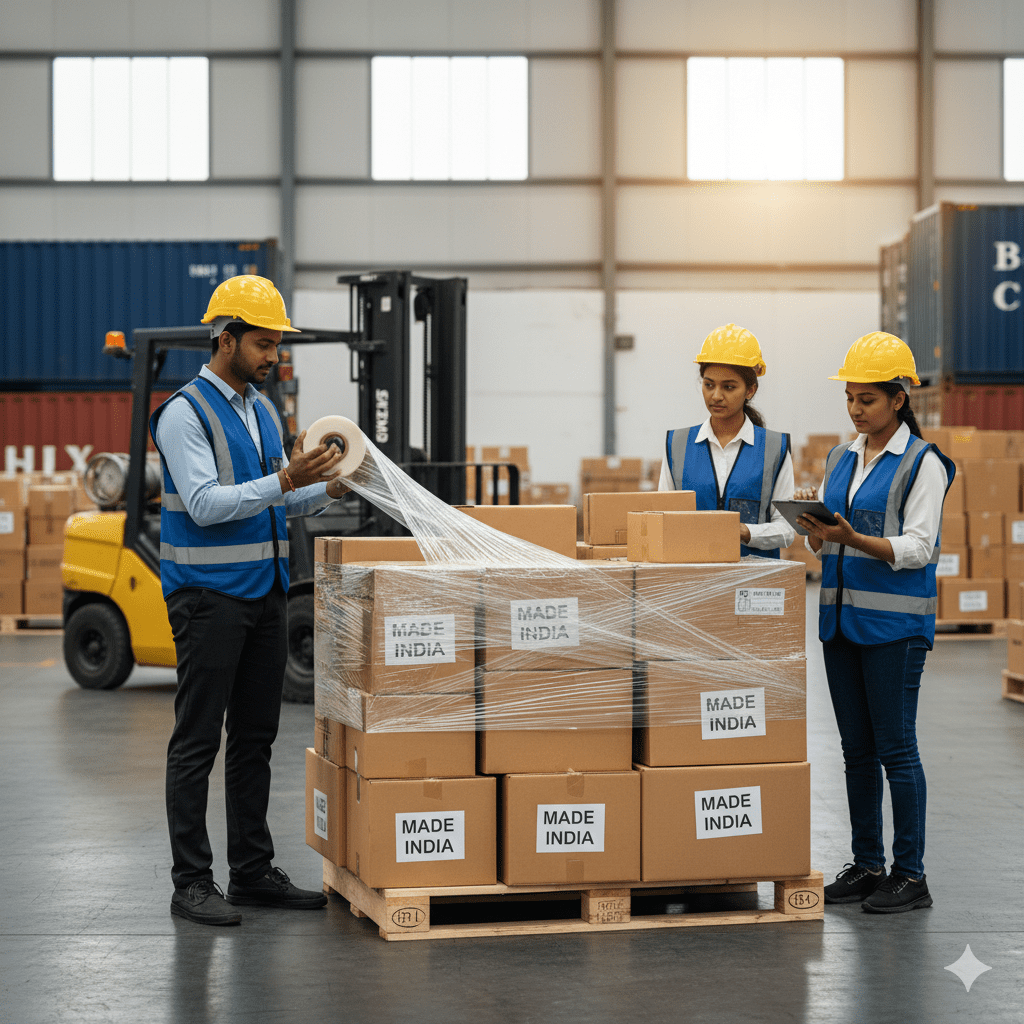
One of the most common questions from buyers considering their first order from India is about minimum quantities. Specifically: do you
have to fill a full container to make the numbers work?
The short answer for most product categories is no.
LCL — Less than Container Load — allows multiple buyers to share space in a single container, each paying only for the volume their cargo occupies. For buyers who are not yet at FCL volumes, or who want to place a trial order before committing to larger quantities, LCL is the practical solution.
This post explains how LCL consolidated shipping from India works, when it makes sense compared to FCL, what the cost implications are, and what to expect from the process.
What is LCL Shipping?
In international sea freight, cargo moves in shipping containers — either 20-foot (TEU) or 40-foot (FEU) containers.
FCL — Full Container Load — means you book and fill an entire container yourself. Your cargo loads at one point and unloads at one destination.
LCL — Less than Container Load — means your cargo shares a container with other buyers’ cargo. A freight forwarder or consolidator collects cargo from multiple shippers, loads it into a single container, and separates it again at the destination for delivery to each buyer.
LCL is charged by volume (cubic metres) or weight (kilograms), whichever is greater — rather than as a flat container rate.
Does NexaCrest Offer LCL for Smaller Orders?
Yes. NexaCrest arranges LCL consolidated shipping for buyers whose order volumes do not fill a full container.
This is particularly relevant for:
First or trial orders — where a buyer wants to evaluate quality and the full process before committing to FCL volumes.
Mixed product orders — where a buyer is sourcing across multiple categories and the combined volume is below a full container.
Buyers building up to FCL — where demand is growing but has not yet reached full-container quantities.
NexaCrest coordinates with established freight forwarders and consolidation services at Indian ports for LCL shipments. The cargo is consolidated at the Indian origin port and deconsolidated at the destination port.
LCL vs FCL — How to Choose
LCL makes sense when:
Your order volume is below approximately 15 cubic metres (roughly half a 20-foot container). You are placing a first order and want to evaluate the product
and process before committing to larger volumes. You are testing a new product category and do not yet know your recurring order volume.
FCL makes sense when:
Your order volume fills or is close to filling a 20-foot container (approximately 25-28 cubic metres) or a 40-foot container. Your cargo requires special handling or isolation from other cargo (fragile goods, sensitive materials, items with specific temperature or humidity requirements). You have predictable, recurring order volumes that justify the container rate.
The cost comparison:
LCL rates are charged per cubic metre (CBM) with a minimum charge — typically 1 CBM minimum. The per-CBM rate for LCL is higher than the equivalent rate on an FCL, but below the FCL break-even point for small volumes, LCL is more economical.
As a rough guide: if your cargo is below 10-12 CBM, LCL is typically more cost-effective. Above 15 CBM, FCL pricing often becomes comparable or better depending on the route.
What to Expect from an LCL Shipment from India
Longer transit time
LCL shipments involve consolidation at origin and deconsolidation at destination. This adds 3-7 days to the transit time compared to FCL on the same route.
Documentation is the same
An LCL shipment requires the same documentation as FCL: commercial invoice, packing list, bill of lading (a House Bill of Lading in LCL), certificate of origin, and any product-specific certificates. The documentation requirements do not simplify because the shipment is smaller.
Cargo handling
In LCL, your cargo is handled more times than in FCL — at the consolidation warehouse, at the destination deconsolidation warehouse, and in transit. Packaging should account for this. Heavy-duty packing for LCL is important, particularly for fragile goods.
Cost visibility
NexaCrest provides full cost breakdowns for LCL shipments: the consolidation fee, the ocean freight per CBM, and destination deconsolidation charges. All costs are confirmed before you commit.
Starting with a Trial Order
If you are considering sourcing from India for the first time and want to evaluate quality and the process before committing to larger volumes, a trial order via LCL is a practical starting point.
It lets you confirm the product matches your specification, see how documentation is managed, and assess whether the supplier relationship is what it appeared to be in commercial discussions — all without the financial commitment of a full container.
NexaCrest handles trial orders with the same process as any other order — the same pre-shipment inspection, the same documentation standards, the same post-delivery follow-up.
To understand the full process from first enquiry to post-delivery: Click here
Interested in a trial order or LCL shipment from India? Tell us what you need
FAQ:
Q: Does NexaCrest offer LCL consolidated shipping for smaller orders?
A: Yes. NexaCrest arranges LCL consolidated shipping for buyers whose order volumes do not fill a full container. This includes trial orders, mixed product orders, and buyers building up to FCL volumes.
Q: What is LCL shipping and how does it work?
A: LCL (Less than Container Load) allows multiple buyers to share a container, each paying for the volume their cargo occupies. Freight is charged per cubic metre or kilogram (whichever is greater). Cargo is consolidated at origin and deconsolidated at destination.
Q: When does LCL make more sense than FCL?
A: Below approximately 10-12 CBM, LCL is typically more cost-effective. Above 15 CBM, FCL pricing often becomes comparable. LCL also makes sense for trial orders regardless of volume, to evaluate quality and process before committing to FCL quantities.
Q: Does LCL take longer than FCL?
A: Yes. Consolidation at origin and deconsolidation at destination add 3-7 days to transit time compared to FCL on the same route.
Q: Is the documentation the same for LCL and FCL?
A: Yes. LCL requires the same commercial invoice, packing list, bill of lading, certificate of origin, and product certificates as FCL. The documentation requirements do not reduce for smaller shipments.
Read more:
Less than Container Load (LCL) shipping